
 Contact:86 25 8968 1211
 Email:jwxie@nju.edu.cn
 Biography
Ji-Wei XIE was born in 1984 and received his bachelor’s degree from the Department of Astronomy at Nanjing University in 2006. He was a PhD student jointly hosted by Nanjing University and University of Florida. He obtained his PhD in 2011, then worked as a post-doc researcher at University of Toronto from 2011 to 2013. Since 2014, he worked as an associate professor and was promoted to Professor in 2020 at the School of Astronomy and Space Science, Nanjing University.
He has been engaged in the theoretical and observational research of exoplanets. His research focuses on large sample surveys of exoplanets, and the formation and dynamical evolution of planetary systems.
 Teaching
Theoretical Mechanics
The frontiers of Astronomy and Astrophysics
 Research Interests
Research Field
Exoplanets: Detection, Characterization, Formation and Evolution
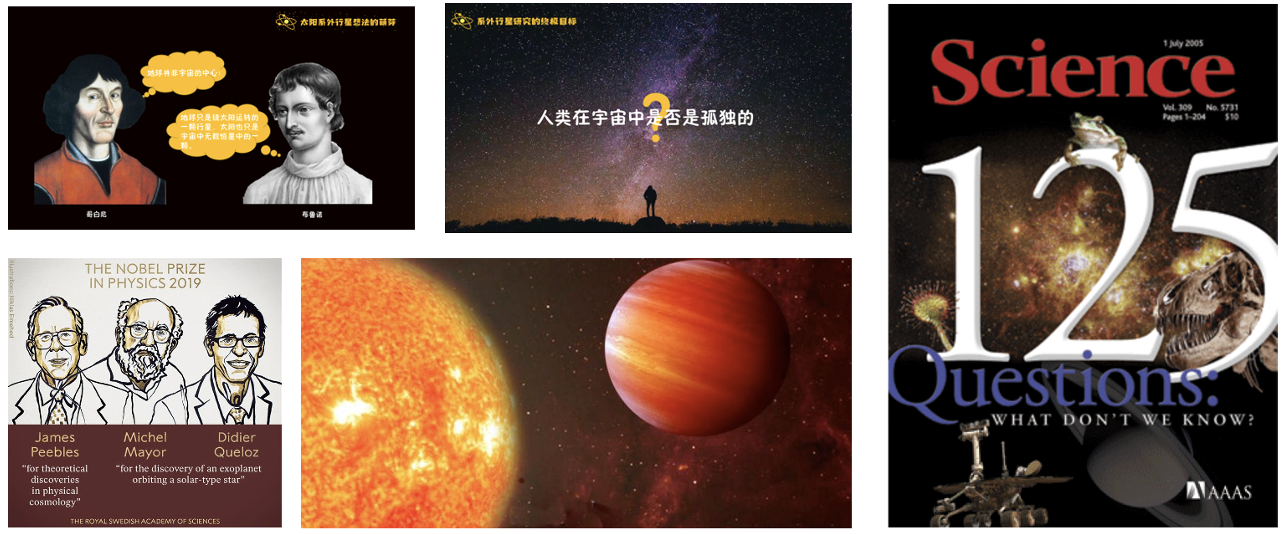
My research focuses on exoplanets. The concept of exoplanets dates back over 400 years to the era of Copernicus and Bruno. In 1995, the first exoplanet orbiting a Sun-like star was discovered, marking the dawn of exoplanetary science. Its discoverers, Michel Mayor and Didier Queloz, were awarded the 2019 Nobel Prize in Physics for this breakthrough. The ultimate question driving exoplanet research is: "Are we alone in the universe?" Translated into scientific terms, this encompasses two key problems:
(1)Is Earth (or the Solar System) unique in the cosmos?
(2)How do planetary systems form and evolve?
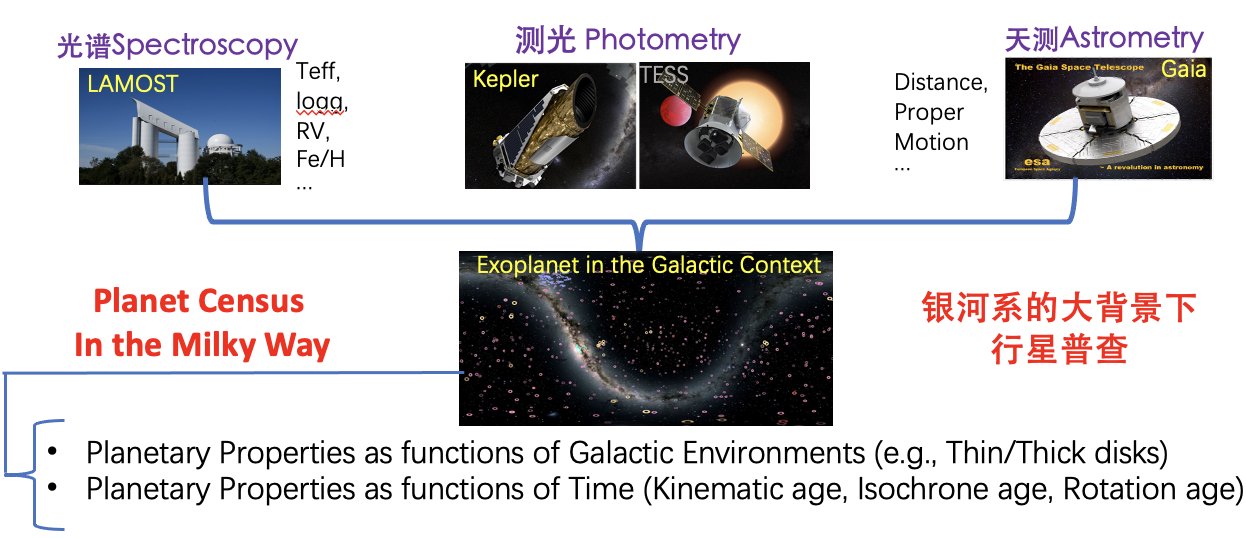
To date, the number of confirmed exoplanets has exceeded 5,000, marking the arrival of a new era of exoplanetary census studies. We are now finally positioned to systematically address those fundamental questions through large-sample statistical analyses. By combining observational data from three major astronomical surveys—LAMOST, Kepler, and Gaia—we can leverage the unique advantages of China's LAMOST telescope in Galactic surveys. This integrated approach enables us to study exoplanet populations within the broader context of the Milky Way, thereby revealing:
(1)The relationship between planetary systems and their galactic environments
(2)Their evolutionary trajectories over cosmic time
Research Group
Current members:
Research Assistants:
YANG,Jia-Yi (杨佳祎);JIANG, Chao-Feng (姜朝峰)
Ph.D students
SHIN, Ke-Ting (辛科霆); ZHANG, Rui-Sheng (张睿晟); SUN, Meng-Fei(孙梦菲)
TU, Pei-Wei (涂培玮);WU, Di (武迪);ZHANG, Xin-Yue (张欣悦);A, Si-Ru (阿斯如)
Previous members:
AN, Dong-Sheng (安东升) Ph.D in 2024
JIANG, Chao-Feng (姜朝峰) Ph.D in 2022, now research assitant in our group
TANG, Wei (唐玮)research assistant in 2022, now graduate student at Imperial College London
SU, Xiang-Ning (苏湘宁) Ph.D in 2021, now faculty in Shaoyang University, Hunan, China
CHEN, Di-Chang (陈迪昌) Ph.D in 2021, now Post-Doc (LAMOST Fellow) in our group
LI, Zi-Fan(李子凡)B.S. in 2022, now PhD student in PMO, China
MO, Fan (莫凡) B.S. in 2022, now PhD student in PMO, China
LIU, Shuai (刘帅) B.S. in 2021, now PhD student in NAOC, China
YANG, Jia-Yi (杨佳祎) Ph.D in 2020, now research assitant in our group
WANG, Zi-Xian (王梓先) B.S. in 2019, now PhD student in University of Sydney, Austrilia
SHEN, Yu-Fu (申育夫) B.S. in 2019, now PhD student in NAOC, China
LIU, Zi-Bo (刘子博) B.S. in 2018, now PhD student in Macau University of Science and Technology, China
ZHANG, Ya-Peng (张雅鹏) B.S. in 2017, now PhD student in Leiden Observatory, Holland
ZHONG, Ze-Hao (钟泽昊) B.S. in 2016, now PhD student in NAOC, China
WANG, Xiao-YU (王啸宇) B.S. in 2016, now PhD student in USTC, China
Research Highlights
"Hot Jupiter Origin Unveiled!", CAS Press Release,Full paper published in Nature Astronomy, 2025
"Earth-Like Planets Prefer Circles", News & Views, Nature Astronomy, 2025
"Evolution of Ultra Short Period Planets (Lava Worlds) ", Nature Astronomy, 2025
"Evolution of Hot Jupiters", In This Issue PNAS, Full paper published in PNAS 2023
"Overview of the LAMOST Survey in the First Decade", The Innovation, 2022
"LAMOST Helps in Planetary Census Across Time and Space" , Chinese Academy of Sciences press release, 2021
"Orbital Spacing Pattern of Planetary Systems with Super-Earths/sub-Neptunes", The Astronomical Journal, 2020
"Occurrence and Architecture of Planetary Systems with Super-Earths/sub-Neptunes" , The Astronomical Journal, 2020
"A power-law decay evolution scenario for polluted single white dwarfs", Nature Astronomy, 2019
"Introducing "Hoptunes", a New Class of Exoplanets", Kavlifoundation News, Full paper published in PNAS, 2018
"The Impact of Stars on Moons", Highlight in AAS NOVA, Full paper published in AJ, 2017
"Orbital Shape Distributions of Exoplanets" , BCAS, Full paper published in PNAS, see also a story at IFL Science News "Lonely Planets Have Crazier Orbits Than Worlds With Companions", 2016
"NASA's Kepler Provides Insights on Enigmatic Planets", JPL news, Full paper published in ApJS, 2014
"41 New Transiting Planets in Kepler Field of View", NASA Kepler news, Full paper published in ApJS, 2012
"Astronomy Without A Telescope – A Snowball’s Chance", UNIVERSE TODAY news, Full paper published in ApJ, 2010
"Nearby Star System Could Support Earth-Like Planet" Space.com news, Full paper published in ApJ, 2010
Recent Projects
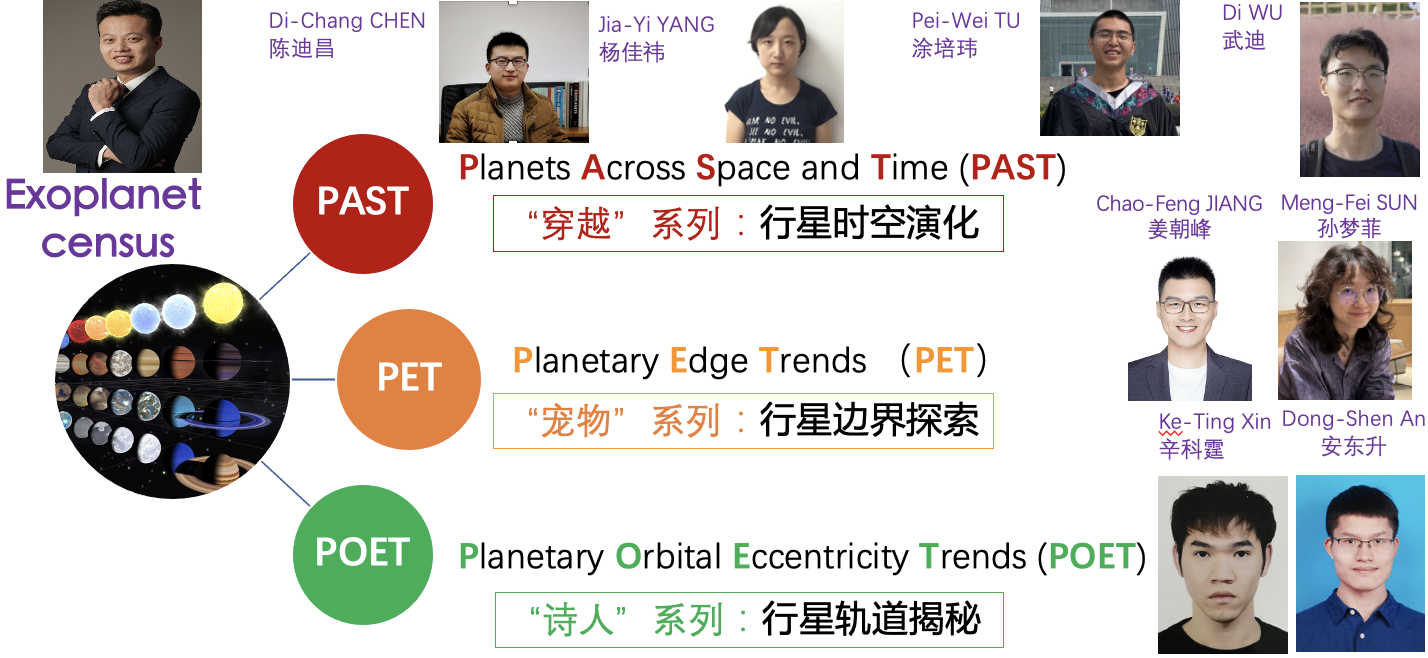
PAST: Planets Across Space and Time (“穿越”系列)
Over 5000 exoplanets have been discovered and thousands of candidates are yet to be confirmed. The discovered exoplanet population has expanded significantly from the solar neighborhood to a much larger area (orders of 1000 pc) in the Galaxy thanks to the improvement of observational technology. We are therefore entering a new era to study exoplanets in the Milky Way Galaxy. In the Galactic context, one of fundamental questions in studying exoplanets is: what are the differences in the properties of planetary systems at different positions (or compitions) of the Galaxy with different ages? To address the question, in a series of papers from here on, we conduct statistical studies of planets at different positions in the Galaxy with different ages, a project that we dub Planets Across Space and Time (PAST). The answer to this question will provide insights on the formation and evolution of the ubiquitous and diverse exoplanets in different Galactic environments.
Publications:
[1] Chen, D.-C., Xie, J.-W., Zhou, J.-L., et al. 2021. Planets Across Space and Time (PAST). I. Characterizing the Memberships of Galactic Components and Stellar Ages: Revisiting the Kinematic Methods and Applying to Planet Host Stars. The Astrophysical Journal 909. doi:10.3847/1538-4357/abd5be
[2] Chen, D.-C., Yang, J.-Y., Xie, J.-W., et al. 2021. Planets Across Space and Time (PAST). II. Catalog and Analyses of the LAMOST-Gaia-Kepler Stellar Kinematic Properties. The Astronomical Journal 162. doi:10.3847/1538-3881/ac0f08
[3] Chen, D.-C., Xie, J.~W., Zhou, J.-L., et al. 2022. Planets Across Space and Time (PAST). III. Morphology of the Planetary Radius Valley as a Function of Stellar Age and Metallicity in the Galactic Context Revealed by the LAMOST-Gaia-Kepler Sample. The Astronomical Journal 163. doi:10.3847/1538-3881/ac641f
[4] Yang, J.-Y., Chen, D.-C., Xie, J.-W., et al. 2023. Planets Across Space and Time (PAST). IV. The Occurrence and Architecture of Kepler Planetary Systems as a Function of Kinematic Age Revealed by the LAMOST-Gaia-Kepler Sample. The Astronomical Journal 166. doi:10.3847/1538-3881/ad0368
[5] Chen, D.-C., Xie, J.-W., Zhou, J.-L., et al. 2023. Planets Across Space and Time (PAST). V. The evolution of hot Jupiters revealed by the age distribution of their host stars. Proceedings of the National Academy of Science 120. doi:10.1073/pnas.2304179120
[6] Tu, P.-W., Xie, J.-W., Chen, D.-C., Zhou, J.-L., 2025. Planets Across Space and Time (PAST). VI. Age dependence of the occurrence and architecture of ultra-short-period planet systems. Nature Astronomy 9, 995. doi: 10.1038/s41550-025-02539-1
PET: Planetary Edge Trends (“宠物”系列)
Our solar system exhibits several key boundaries—such as the inner edge (marked by Mercury’s orbit at ~0.4 AU), the middle edge (the asteroid belt), and the outer edge (the Kuiper Belt or Oort Cloud)—which offer critical insights into its formation and evolution. With the discovery of thousands of exoplanets, we now extend this framework to exoplanetary systems, investigating how these edges depend on stellar and planetary properties. Such studies promise to deepen our understanding of planetary system architecture and evolution.
Publications:
[1] Sun, M.-F., Xie, J.-W., Zhou, J.-L., et al. 2025, Planetary Edge Trends (PET). I. The inner edge – stellar mass correlation. Astronomy & Astrophysics, 699, 333. doi: 10.1051/0004-6361/202553671
POET: Planetary Orbit Eccentricity Trends (“诗人”系列)
Orbital eccentricity is one of the fundamental parameters in planetary dynamics, which provides crucial constraints on planet formation and evolution. Based on the fact that the solar system's planets have small orbital inclinations and eccentricities, Kant and Laplace in the 18th century put forward that the solar system formed from a nebula disk, laying the foundation for the modern theory of planet formation. Since the discovery of 51 Pegasi b in 1995, the number of exoplanets has increased dramatically. Furthermore, various surveys of spectroscopy and astrometry provide comprehensive characterizations for the host stars of exoplanets, allowing one to statistically study the relationship between stars and planets. Here we start a project, Planetary Orbit Eccentricity Trends (POET), to investigate how orbital eccentricities of planets depend on various stellar/planetary properties.
Publications:
[1] Xie, J.-W., Dong, S., Zhu, Z., et al. 2016, Exoplanet orbital eccentricities derived from LAMOST-Kepler analysis. Proceedings of the National Academy of Science, 113, 11431. doi:10.1073/pnas.1604692113
[2] An, D.-S., Xie, J.-W., Dai, Y.-Z., Zhou, J.-L. 2023. Planetary Orbit Eccentricity Trends (POET). I. The Eccentricity-Metallicity Trend for Small Planets Revealed by the LAMOST-Gaia-Kepler Sample. The Astronomical Journal 165. doi:10.3847/1538-3881/acb533
DEB: Demographics of Exoplanets in Binaries (“新秀”系列)
Stars are thought to be commonly born and found in binary/multiple systems. Therefore, the demographics of exoplanets in binaries play a crucial role in statistically studying the whole exoplanet population in our Galaxy. Furthermore, the diverse orbital configurations and rich dynamics in planet-bearing binary systems provide valuable conditions to test various theories and models of planet formation and evolution. Here, we conduct a series of studies on the Demographics of Exoplanets in Binaries (DEB), aiming to find patterns from observations to deepen our understanding of planet formation and evolution.
Publications:
[1] Su, X.-N., Xie, J.-W., Zhou, J.-L., et al. 2021. Demographics of Exoplanets in Binaries. I. Architecture of S-type Planetary Systems Revealed by the Radial-velocity Sample. The Astronomical Journal 162. doi:10.3847/1538-3881/ac2ba3
 Publications