 Contact:025-89681251
 Email:kpqiu@nju.edu.cn
 Biography
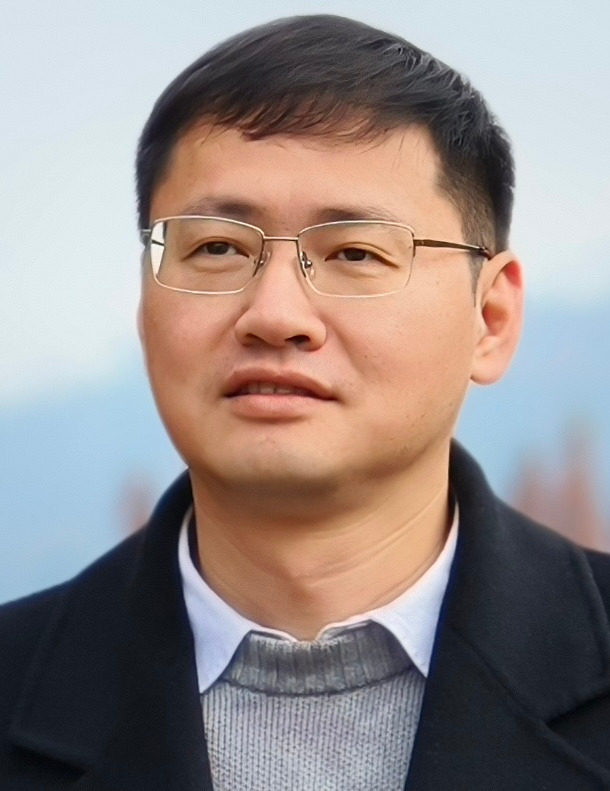
Keping Qiu is a Professor at the School of Astronomy and Space Science, Nanjing University. He received his B.S. from Nanjing University in 2002 and his Ph.D. in astronomy from Nanjing University in 2009. From 2006 to 2009, he carried out his doctoral research at the Harvard-Smithsonian Center for Astrophysics (CfA) as a CfA Pre-doctoral Fellow, and from 2010 to 2012 he was a postdoctoral fellow at the Max Planck Institute for Radio Astronomy (MPIfR). He was supported by the Young Overseas Talents Recruitment Program of China in 2012, and then joined the faculty of School of Astronomy and Space Science, Nanjing University. He has been awarded funding from the National Natural Science Foundation of China and National Key R&D Program of China, including the Distinguished Young Scholars grant. He has published more than 100 papers in peer-reviewed astronomy journals. He has been engaged in various academic services, including chairing the Time Allocation Committee of the Five-hundred-meter Aperture Spherical radio Telescope (FAST) and joining the ISM science review panel for the NRAO/GBO proposals.
 Teaching
Observational Astrophysics
As a core course for undergraduates majoring in astronomy in Nanjing University, the course introduces the principles and fundamental methods of astrophysical observations, as well as the the existing and future world-leading observing facilities.
 Research Interests
1) Star Formation
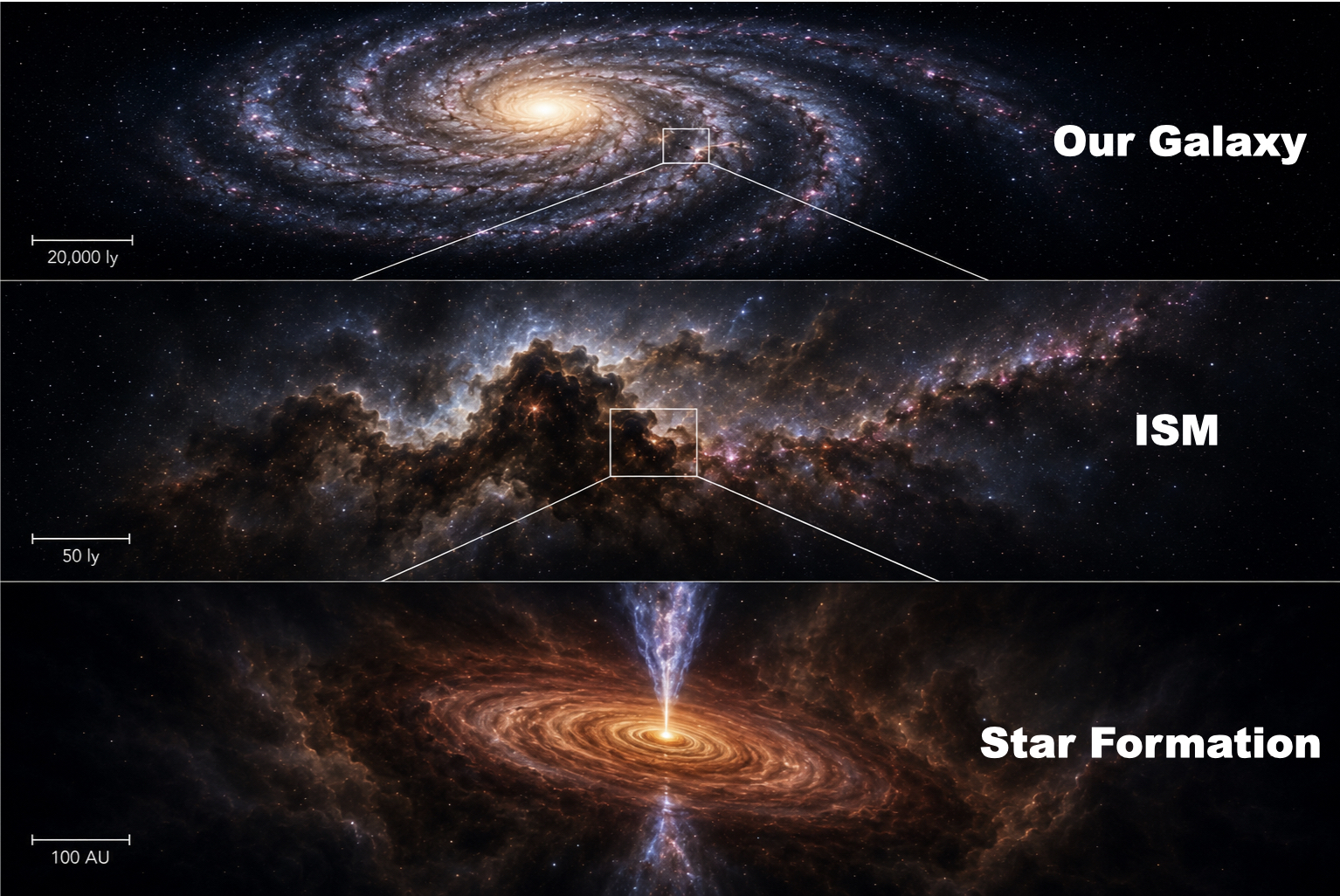
We study the formation and evolution of gas structures across a wide range of scales, from giant molecular clouds (~100 pc) to protostellar envelopes (~1000 au) and protostellar disks (~10–100 au). Current topics include the collapse and fragmentation of hierarchical structures in the interstellar medium; the formation and evolution of jets, outflows, and accretion disks around protostars and young stellar objects (YSOs); the formation and evolution of ultra-compact and hyper-compact HII regions (UC HII, HC HII); the formation of massive stars; and the origin of binary and multiple stellar systems.
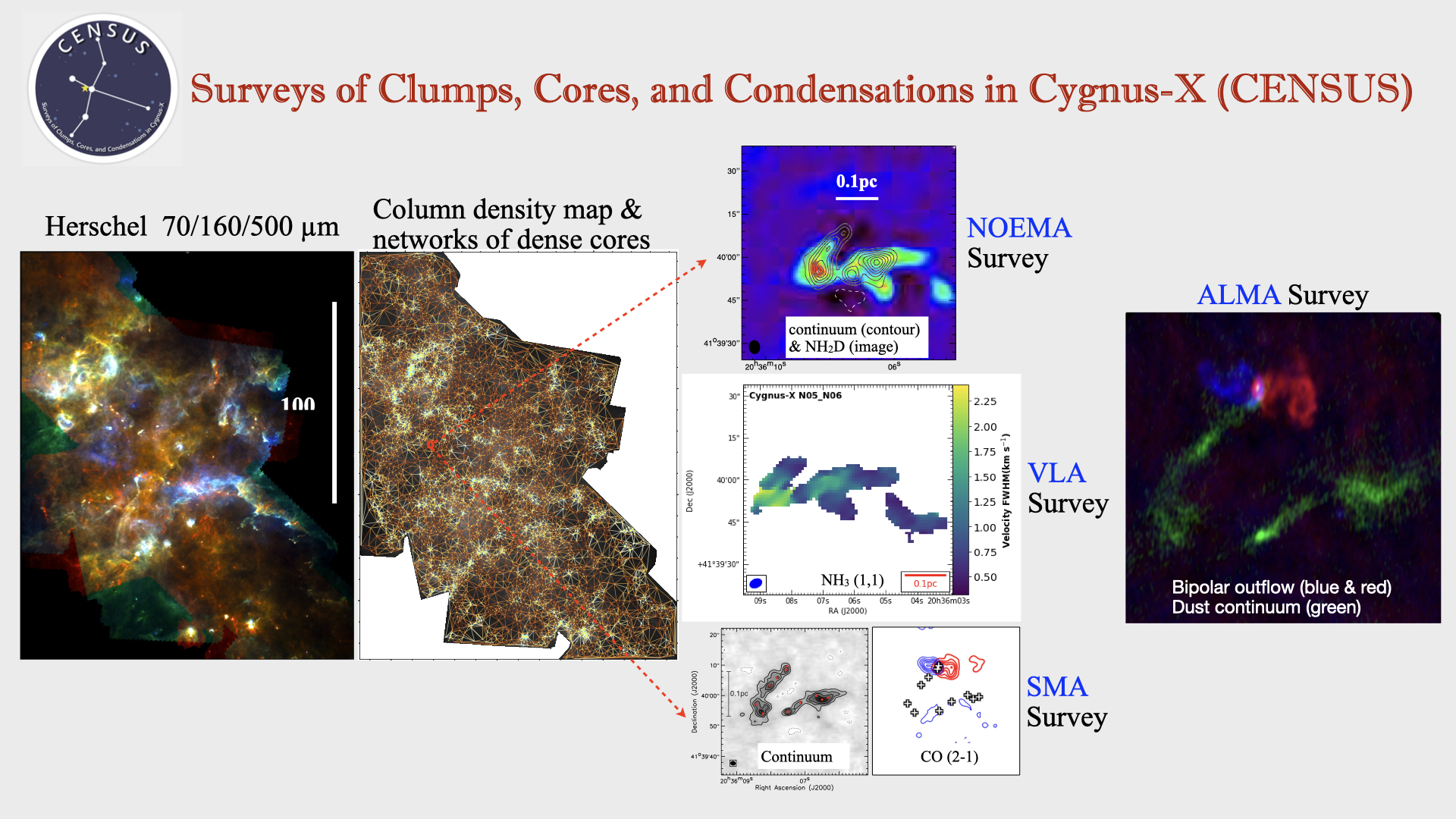
Part of the publications from CENSUS:
Cao, Qiu et al. 2019, ApJS, 241, 1; Cao, Qiu et al. 2021, ApJ Letters, 918, L4; Li, Cao, Qiu 2021, ApJ, 916, 13; Wang, Qiu et al. 2022, ApJ, 927, 185; Yang, Qiu et al. 2024, A&A, 684, A140; Pan, Qiu et al. 2024, A&A, 684, A141; Zhang, Qiu et al. 2024, A&A, 684, A142; Pan, Qiu et al. 2025, A&A, 696, A195; Li & Qiu 2026, A&A, 707, A194; Xing & Qiu 2026, AJ, 171, 152
2) Dust Polarization and Magnetic Field
Using millimeter and submillimeter dust polarization observations, we map the magnetic field morphology in molecular clouds and star-forming regions. Combined with gas kinematics from molecular-line observations and with magnetohydrodynamic (MHD) simulations, these data let us probe the role of magnetic fields in the formation and evolution of molecular clouds and in subsequent star formation. We are also interested in measuring the line-of-sight component of the magnetic field through the Zeeman effects in atomic absorption lines and molecular emission lines, in preparation for upcoming campaigns with the Square Kilometre Array (SKA).
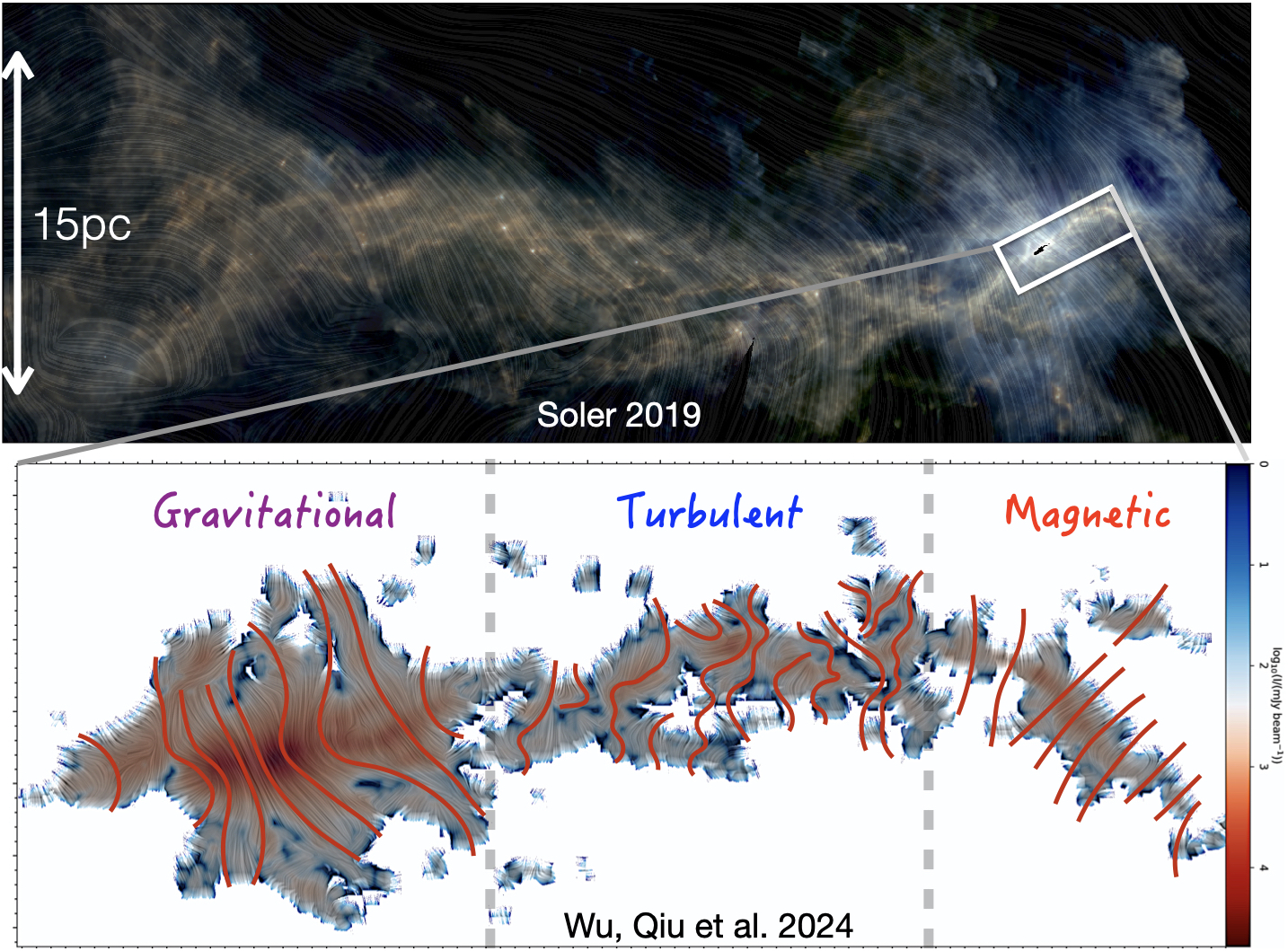
Part of the publications in dust polarization and magnetic field:
Liu, Qiu et al. 2019, ApJ, 877, 43; Ching, Qiu et al. 2022, ApJ, 941, 122; Wu, Qiu et al. 2024, ApJ Letters, 977, L31; Zhao, Qiu et al. 2026, ApJ, in press (arXiv:2605.17708); Mo, Qiu et al. 2026, AJ, in press;
I am also a co-PI of the BISTRO survey, which is currently the largest dust polarization survey targeting molecular clouds within the Milky Way (BISTRO homepage).
3) HI Survey of the Milky Way
Using large-scale neutral hydrogen (HI) surveys with FAST and the future SKA, we study the spiral arms and large-scale gas structures of the Milky Way. A particular focus is the gas in the outer Galaxy and at the edge of the Galactic disk, and the transition from atomic to molecular gas in the interstellar medium.
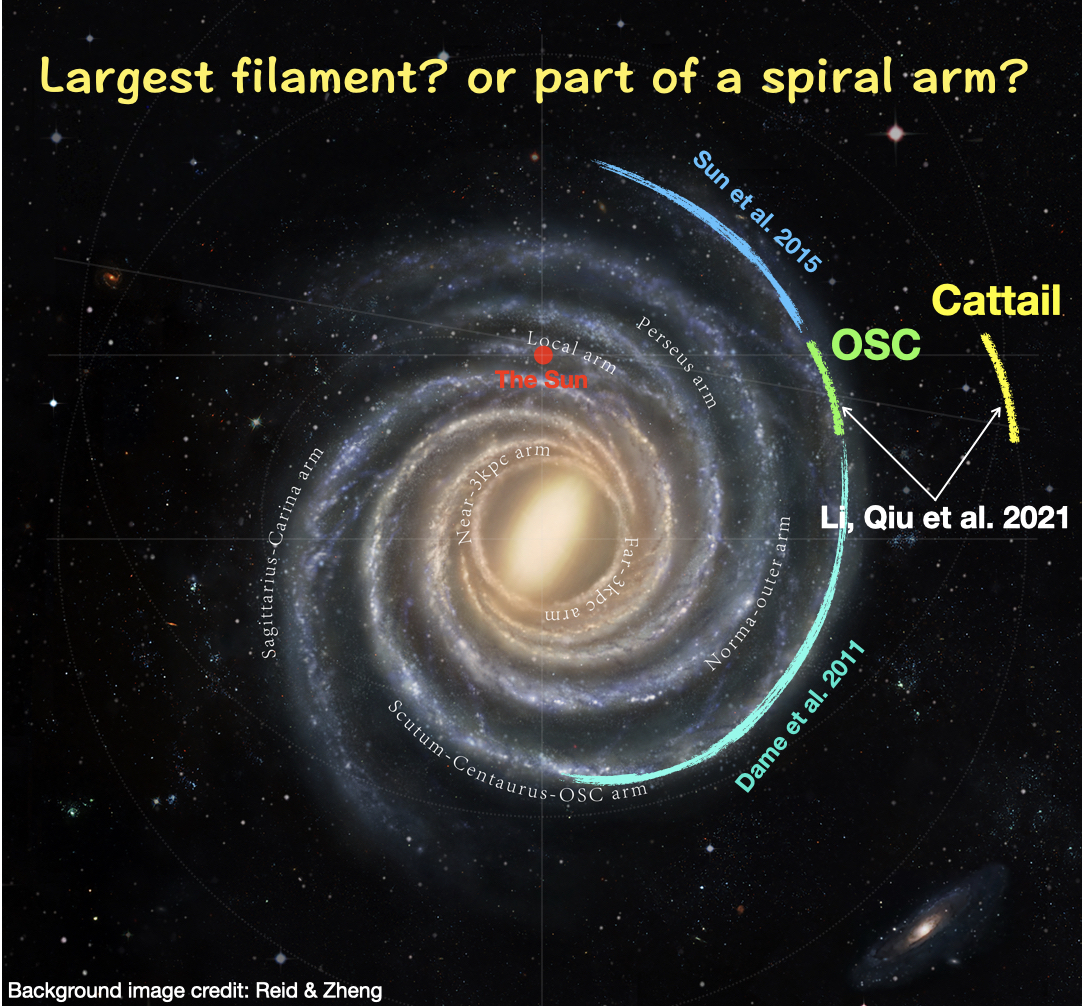
Part of the publications in FAST HI surveys:
Li, Qiu et al. 2021, ApJ Letters, 918, L2; Li, Qiu et al. 2023, ApJ Letters, 948, L17
Media Coverage & Press Releases:: Live Science, New Scientist, CCTV.
More about FAST and radio astronomy
Team and Recruitment
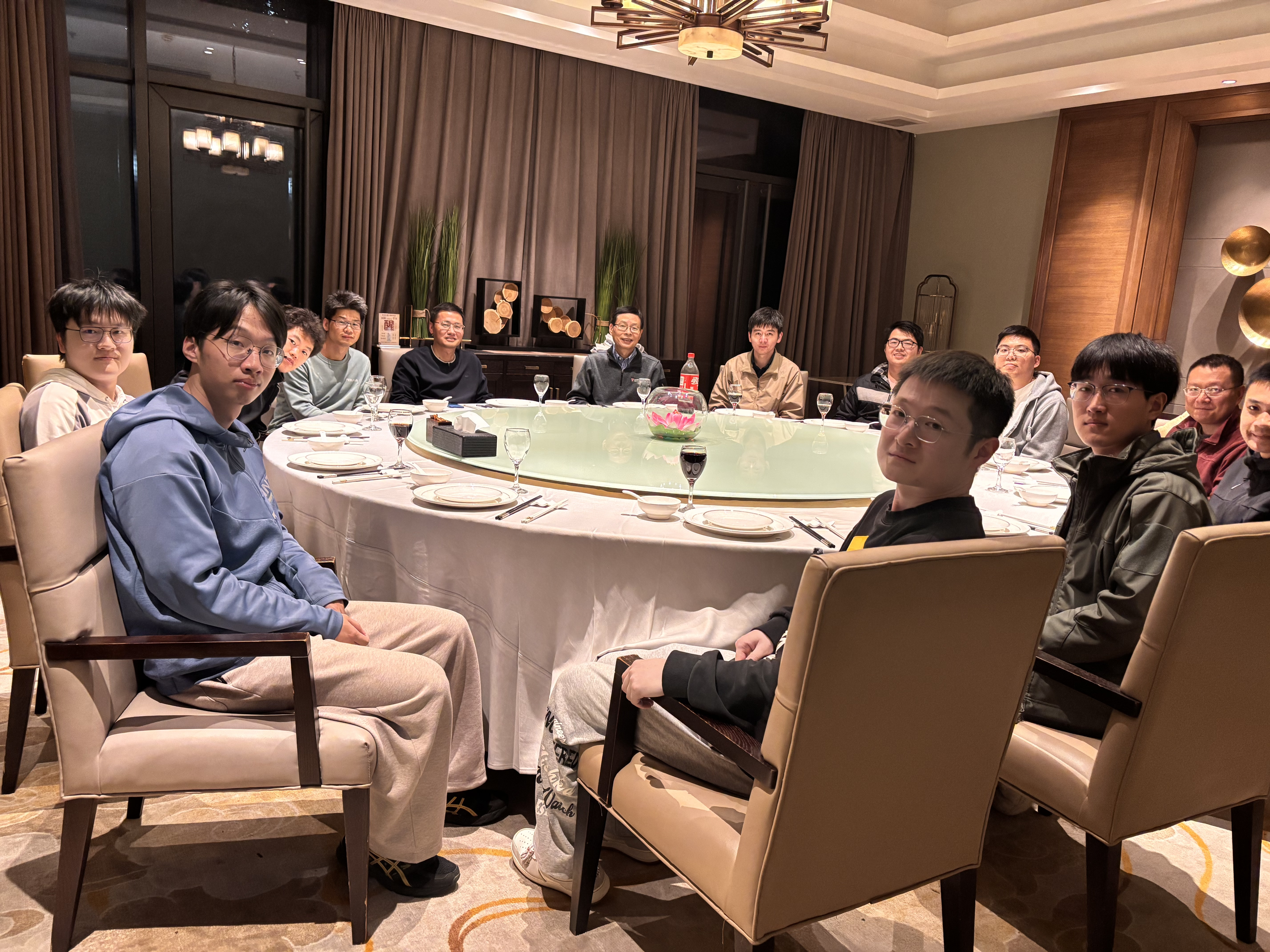
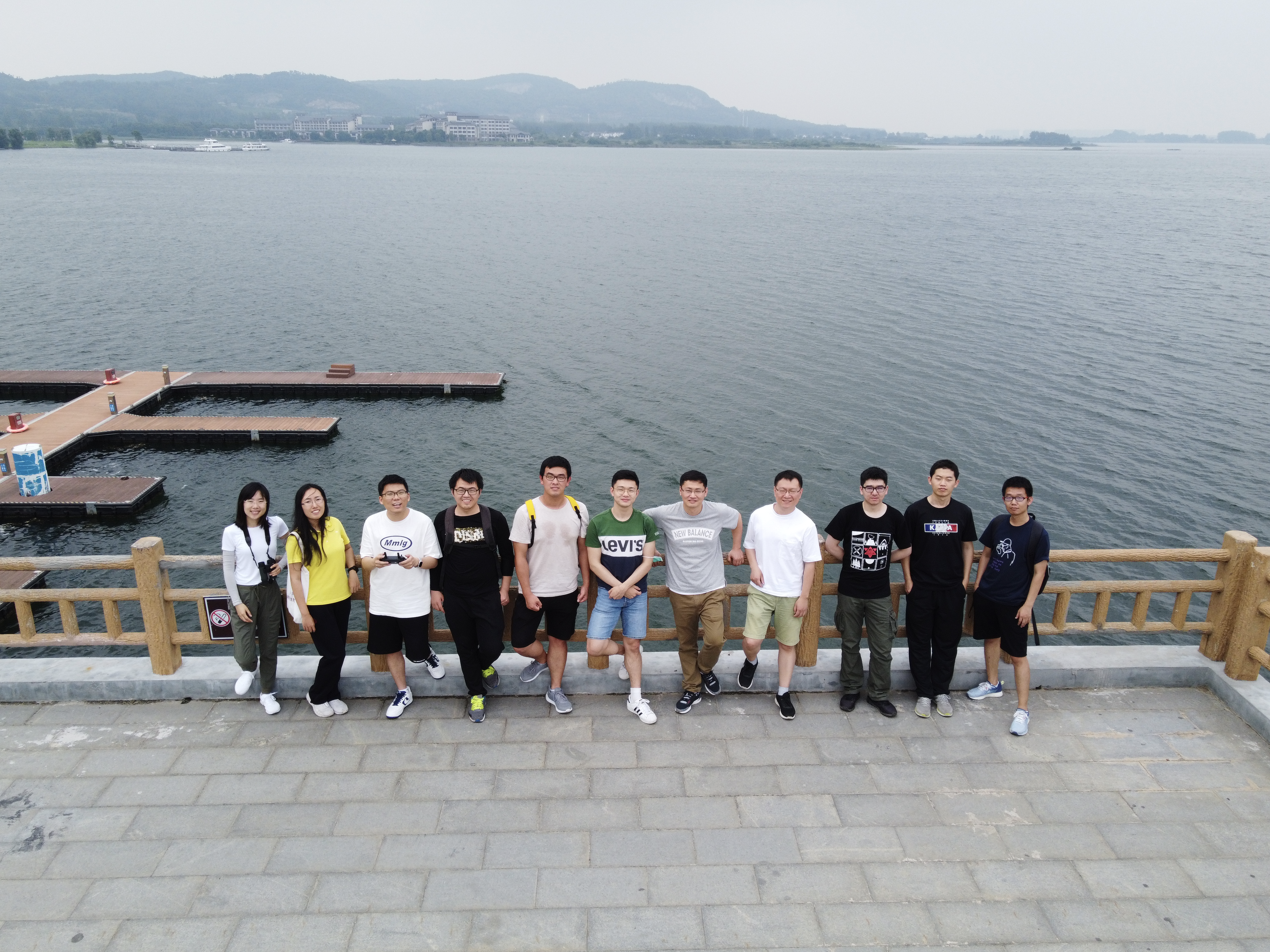
We have a very young and active team composed of young faculties, postdocs, and students. If you are interested in star formation, ISM, or radio astronomy, and considering doing a PhD/Master or postdoc in these fields, please feel free to contact me. Applications for research or tenure-track positions are also welcomed.
|
|
 Publications